The Weight Of Quiet: Body As Language
The Concept
There are projects that begin with a concept, and projects that begin with a feeling. This one began with a feeling I could not yet name: something between exhaustion and suspension, the particular stillness of a person who has stopped performing for the world and turned entirely inward. I wanted to photograph that state. Not illustrate it, not narrate it; photograph it, with the same directness and economy I would bring to any document of the real.
My starting point was subtraction. I wanted to strip the frame of everything that was not essential: no textured backdrop, no warm tonal gradient, no period reference, no prop. Just a figure, a garment, and a light source working against near-total darkness. The black background is not a stylistic choice in the decorative sense; it is a structural one. It eliminates context, removes the subject from any legible space or time, and forces the entire emotional weight of the image onto the body itself.
What interested me was the body as a primary expressive instrument: not the face, not the gaze, not the conventional grammar of portraiture. The hands pressing into the skull. The spine curved forward under invisible pressure. The arms crossing over the chest in a gesture that reads simultaneously as self-protection and self-containment. These are not directed poses in the conventional sense. They are physical states that I asked Giulia to inhabit and hold, and then I waited until the holding itself became the image.
The sketches I developed in pre-production reflect this approach: rough compositional studies focused almost exclusively on the silhouette and the relationship between the figure and the surrounding void. Where in the Miranda series my pre-production drawings concerned themselves with light architecture and tonal gradients, here they were almost exclusively about the geometry of the human body against darkness.

Location and Technical Setup
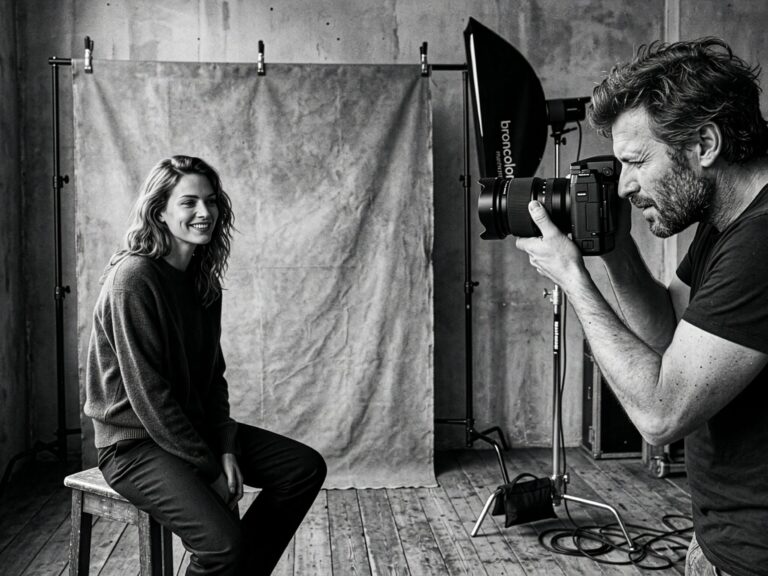
The series was shot entirely in my Rome studio. I used a single light source: a medium strip box positioned to the subject’s left at a steep downward angle, with no fill and no reflector. The resulting light is hard-edged on the illuminated side and drops off sharply into shadow, producing the chiaroscuro quality that runs through every frame. The backdrop is a seamless deep charcoal, rendered virtually black by the absence of fill light. In post-processing I extended the shadow density further, but the tonal signature of the series was established in the original capture. I am always cautious about darkness that is manufactured in post; the best dark images are dark from the moment the shutter closes.
The floor, visible in several frames where Giulia sits or kneels directly on it, becomes an extension of the backdrop: the figure emerging from and dissolving into the same continuous darkness. This was intentional. I did not want a clear horizon line separating the subject from the ground. I wanted the impression of a figure suspended in an undifferentiated space.

Casting: Giulia
Casting for this kind of work requires a specific quality that is genuinely difficult to articulate without sounding imprecise. I needed someone who could surrender physical self-consciousness completely: who could bend, fold, turn away from the camera, obscure her own face, without the body reading as passive or disconnected. Giulia brought exactly this quality. She has an innate understanding of her own physicality, a willingness to commit to a state rather than merely approximate it, that made her the right subject for a series built almost entirely on physical expression rather than facial performance.
There is one frame in the series where she looks directly into the lens: hands raised to her chin, spine upright, gaze level and undeflected. I kept it because it functions as a kind of punctuation within the series; a moment of confrontation embedded in a sequence of withdrawal. Without it, the work risks becoming entirely self-enclosed. With it, the viewer is addressed, briefly and directly, before the subject turns away again.

The Garment
The styling decision was as reductive as the lighting one. A single white cotton and lace dress, ankle-length, spaghetti-strapped, with lace trim at the hem and waist, worn throughout the entire series without variation. The choice of white against near-black darkness is compositionally obvious in one sense, but it carries specific connotations that I found useful: fragility, vulnerability, the domestic and the intimate. The lace detail is period-ambiguous; it could belong to a Victorian nightgown or a contemporary slip dress, which is precisely why I chose it. I did not want the garment to anchor the series in any specific historical moment. I wanted it to exist slightly outside of time, as the emotional states it surrounds are themselves timeless.
There is no visible hair styling and no makeup in the conventional editorial sense. The hair is loose, unstyled, moving with the body; in several frames swept forward across the face entirely, reinforcing the sense of withdrawal and concealment. This was a deliberate direction. Any visible styling apparatus would have reintroduced the performance of self-presentation that the series is specifically working against.

Reading the Sequence
A series like this lives or dies on its internal sequencing logic. The six images I have selected move through a coherent emotional arc: from acute distress, the opening frame with hands buried in hair and face entirely hidden, through progressive degrees of self-containment and partial emergence, toward the single moment of direct eye contact, and then back into withdrawal. The closing image, standing with arms crossed over the chest and gaze downward, returns the figure to a state of quiet enclosure; but with a different quality than the opening. The opening reads as involuntary. The closing reads as chosen.
That distinction is the centre of the series.

Final Thoughts
The Weight of Quiet is the kind of work I return to as a corrective: a reminder that the most demanding images are often the ones that ask the least of their viewer in terms of narrative scaffolding. There is nothing here to decode, no reference to identify, no period to place. There is only a body in a room, and the question of what that body is carrying.
For photo editors working in the space where fashion and fine art portraiture intersect, I believe this series offers something that sits with a reader after the page is turned; which is, ultimately, the only thing I am trying to make.

The Team
Photographer: Michele Belloni (@_michelebelloni)
Model: Giulia Carrara (@_giulia_carrara)
Make Up Artist: Sabrina Brunori (@sabrinabrunori_makeupartist)
Hair Stylist: Sabrina Brunori (@sabrinabrunori_makeupartist)