The Shadow of the Forties: An Italian Neorealist Study in Quiet Dignity
In this journal entry, we analyze a studio portrait that shifts its gaze back to one of the most volatile and artistically fertile decades in European history. The image stands as a deliberate exploration of 1940s Italian identity, channeling the raw emotional gravity and austere elegance of early neorealist cinema into a contemporary fine art context.
The Conceptual Vision and Intended Communication
The core ambition of this project was to evoke the psychological landscape of Italy during the 1940s: a decade defined by wartime anxiety, occupation, and the subsequent, bittersweet dawn of liberation. Cinematically, this era marked a radical departure from the glossy, escapist “White Telephone” (Telefoni Bianchi) films of the previous decade, giving birth instead to a raw, deeply human realism. This photograph was conceived to capture that exact historical pivot: the transition from structured formality to unvarnished, internal truth.
The image communicates a profound sense of resilience wrapped in vulnerability. The tightly buttoned collar and tailored shirt reference the modesty, austerity, and material rationing of the wartime era. However, the narrative is truly driven by the subject’s posture. The hand resting delicately against the throat is not a gesture of vanity, but one of self-preservation and hesitation: as if catching a breath or holding back an unspoken confession. It is an invitation to witness a silent, internal monologue shaped by the weight of a turbulent era.
The Muse: Why Miranda Was Chosen
Recreating the emotional depth of 1940s cinema requires a subject capable of conveying immense narrative weight without relying on modern, performative expressions. Miranda was chosen as the vital collaborator for this frame because her features carry a timeless, dramatic intensity reminiscent of the great actresses of early Italian Neorealism, such as Anna Magnani or Clara Calamai.
Miranda possesses an exceptional bone structure that thrives under high-contrast, directional lighting. Her large, expressive eyes hold a striking, melancholic clarity that serves as the absolute psychological anchor. On set, she demonstrated an innate understanding of the era’s gravitas, holding a rigid, almost statuesque composure while allowing her gaze to express a deep, complex vulnerability. Her rich, dark hair, swept back yet voluminous and slightly untamed, introduces a subtle element of organic chaos to the frame, symbolizing an underlying emotional storm held back by sheer dignity.

Technical Execution and Studio Lighting Design
To translate the high-contrast, atmospheric quality of 1940s black-and-white cinematography into a rich, muted color portrait, the technical approach required absolute precision in shadow management and light fall-off.
The background, a painted canvas rich in earthy tones and subtle textures, was placed several feet behind Miranda. It was kept completely dark, catching only the barest minimum of stray light to provide just enough separation to prevent her dark hair from dissolving into total obscurity.
The final lighting scheme was designed as a modern homage to the dramatic, low-key lighting of mid-century film sets, relying on a strict subtractive methodology:
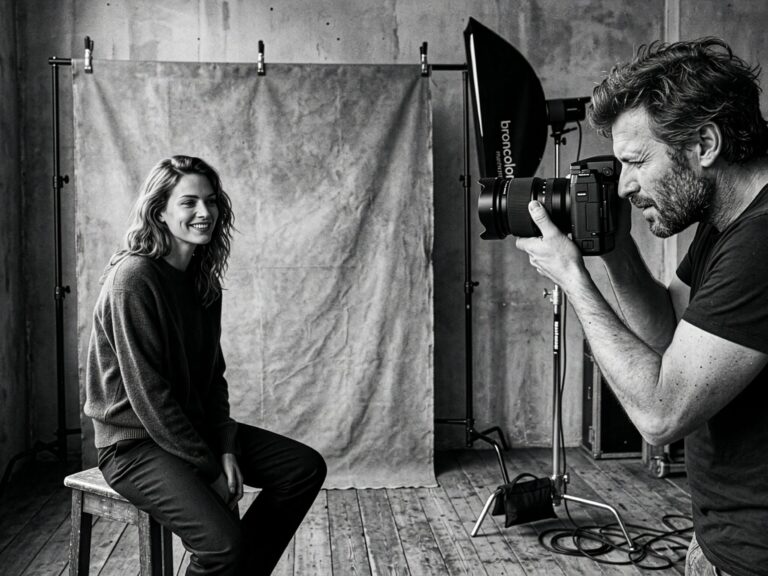
- The Key Light: A large, double-diffused Octabox was positioned to camera right, elevated at a 45-degree angle and tilted downward toward the subject.
- The Modifiers: Crucially, a heavy fabric grid was attached to the Octabox to constrain the spread of light. This restricted the beam, preventing it from scattering across the studio and flattening the mood.
- The Feathering Technique: Instead of aiming the axis of the softbox directly at Miranda, the light was heavily feathered across her profile. This ensured that only the soft, wrapping edge of the light beam illuminated her face, creating beautifully smooth, painterly transitions across her cheekbones and the silk fabric of her shirt.
- The Fill Light: On camera left, a small flash was positioned close to the subject to create a small amount of diffused light. This completely starved the shadow side of fill light, creating deep, ink-like blacks that mimic the high-contrast silver halide look of 1940s film while preserving the exquisite tactile detail of the digital medium.

The Team
Photographer: Michele Belloni (@_michelebelloni)
Model: Miranda Pulsoni (@miranda.pulsoni)
Make Up Artist: Valentina Montalto (@valentinamontalto_photomua)
Hair Stylist: Liliana Benocci (@parrucchierinuoveimmagini)